
Old Norse Translator – English to Old Norse & Old Norse to English (Viking Language)
The Old Norse translator is a fast, human-friendly tool to convert text between English and Old Norse—use it as an English to Old Norse translatoror an Old Norse to English translator in a single place. For quick visuals, it also offers a runic output mode, and for meaning, it provides AI translation, so it works as a practical Norse translator and a helpful “Viking language translator” for names, phrases, and short texts.
Whether exploring myth, saga, or everyday phrases, this tool helps bridge the gap from modern English to historical Old Norse. If runes are the goal, the runic mode displays characters in the Norse runic alphabet (including Elder Futhark references), while AI translation focuses on meaning—ideal when the task is true translation rather than a visual transliteration.
What is Old Norse (Viking Language)? 🤔
Old Norse was the North Germanic language spoken across Scandinavia and in overseas settlements, overlapping the Viking Age and preserved in sagas and poetry; it is the parent of modern Icelandic, Faroese, and Norwegian.
In everyday searches, people often say “Viking language” or “ancient Norse”; when using a norse language translator, the historical term to look for is Old Norse, while “Nordic translator” refers more broadly to the modern Scandinavian language family rather than this specific medieval tongue.
Old Norse was written using runes in earlier periods and later Latin letters; during the Viking Age the Younger Futhark runic alphabet with 16 characters was prevalent, so a runic output is a script choice rather than a separate language.
Old Norse Translator – What does it do? 🛡️
This tool works both ways as an English to Old Norse translator and an Old Norse to English translator, so it’s useful whether the goal is to understand a phrase from a saga or to render a modern name into historical form.
It offers two outputs: a runic mode for visual transliteration into the Norse runic alphabet (including Elder/Younger Futhark context), and an AI translation mode aimed at meaning—making it a practical Norse language translator and a helpful “Viking language translator” for short texts, names, and captions.
Character-by-character runic transliteration
Choose the runes option to display text in a runic script—this is a letter-for-letter substitution that produces a visually striking output without changing the underlying language.
Historically, the runic alphabet evolved from the 24-character Elder Futhark to the 16-character Younger Futhark used during much of the Viking Age; our visual mapping references this tradition so the output looks period-appropriate.
Character by character runic transliteration: example
Here’s a quick example that shows how English letters are replaced with corresponding runic symbols for a visual “English to runes” effect.
Original Text (English)
You can't understand the ocean's tide without knowing the moon
Character-by-character runic output (visual)
ᚤᛟᚢ ᚲᚨᚾ'ᛏ ᚢᚾᛞᛖᚱᛋᛏᚨᚾᛞ ᛏᚺᛖ ᛟᚲᛖᚨᚾ'ᛋ ᛏᛁᛞᛖ ᚹᛁᛏᚺᛟᚢᛏ ᚴᚾᛟᚹᛁᚾᚷ ᛏᚺᛖ ᛗᛟᛟᚾImportant: This runes mode is not a linguistic translation—it’s a visual transliteration into a runic alphabet and should not be used as a literal Old Norse translation.
AI translation
Select AI translation for meaning-focused results that approximate Classical Old Norse; it’s best for short phrases and names, and it supports both directions (Norse to English translator and English to Norse translator).
AI translation: example
Here’s the same line rendered with the AI translation mode for a meaning-first result.
Original Text (English)
You can't understand the ocean's tide without knowing the moon
AI Translation (Old Norse)
Þú getur ekki skilið sjávarföll án þess að þekkja tungliðImportant: AI results are approximations; Old Norse is historical, and vocabulary/grammar vary by source, so treat outputs as a starting point and verify when precision matters.
Optional audio (when available)
When enabled, the Old Norse translator with audio lets listeners hear an approximate pronunciation of the output via text‑to‑speech; pronunciation is necessarily imperfect for a historical language but useful for quick reference.
Runic vs AI: which should you use?
Choose runes mode when the goal is a visual “runic alphabet translator” effect (sometimes called a “Viking runes translator” or “Nordic runes translator”); choose AI translation when meaning and readability matter.
How to Use the Old Norse Translator (English to Old Norse & Old Norse to English) 📜
This guide shows how to run an English to Old Norse translation or an Old Norse to English translation, and when to choose AI vs a runic “English to runes” output.
Paste or type the text to translate—either English or Old Norse—depending on whether the goal is English → Old Norse or Norse → English.
Select the direction: English to Old Norse translator or Old Norse to English translator, which helps the tool match the intended output.
For meaning, use AI Translation; for a visual effect, use the runic mode (a transliteration into the Norse runic alphabet), noting Elder vs Younger Futhark context from history.
If available, enable the Old Norse translator with audio to hear an approximate pronunciation; Old Norse is historical and pronunciation is reconstructed from scholarly work.
Press Translate to generate results; expect AI output for meaning and a separate runic output for visual script, which is not a linguistic translation.
Copy the output for names, captions, or short phrases, and verify important passages against reputable resources when precision matters.
Example: English to Old Norse and English to Runes
AI Translation (English to Old Norse)
Original (English)
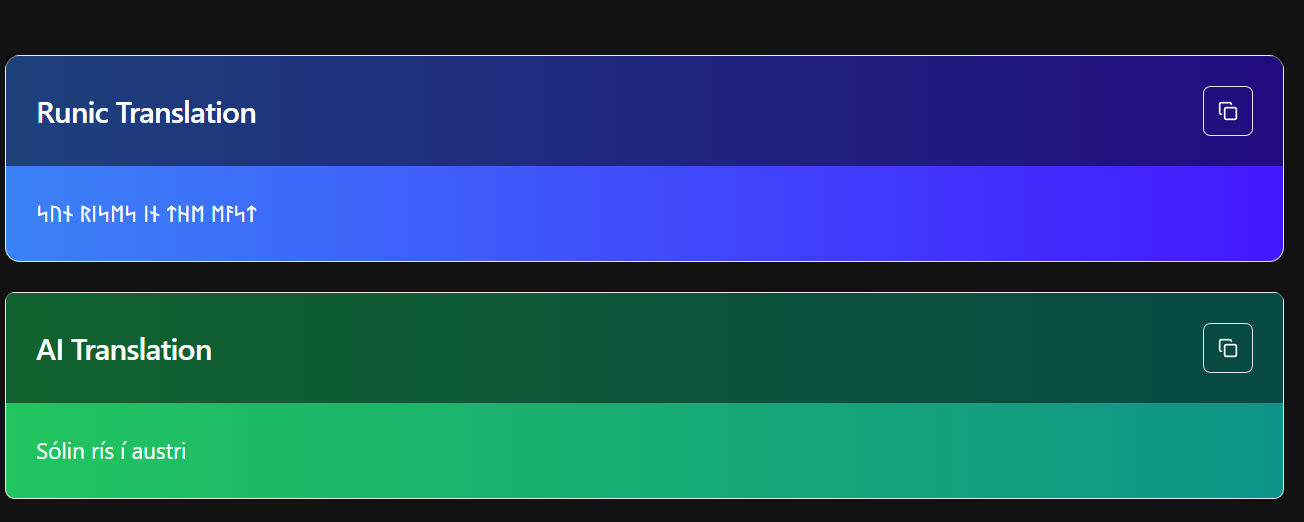
Sun rises in the east
AI Translation (Old Norse)
Sól rís í austriRunic Output (English to Runes, visual transliteration)
This is a letter‑for‑letter runic transliteration for a visual effect; runes are a writing system (Elder/Younger Futhark), not a separate language.
Original (English)
Sun rises in the east
Visual Transliteration (Runic Alphabet)
ᛋᚢᚾ ᚱᛁᛋᛖᛋ ᛁᚾ ᛏᚺᛖ ᛖᚨᛋᛏImportant: This is not a linguistic translation; it’s a visual script mapping, and Viking‑Age usage typically drew on the 16‑character Younger Futhark.
Why Use an Old Norse Translator? 🤔
Whether the goal is a quick Old Norse translation for a phrase or a Norse translation of a name, this tool keeps things simple while offering both meaning-focused AI output and a visual runic option.
- Translate both ways 🔄: Run English to Old Norse or Old Norse to English with one click—ideal for captions, short texts, and names.
- Choose meaning or visuals 🎯: Use AI for readable Old Norse translation, or switch to an English to runes output for a runic alphabet look inspired by historical Futhark.
- Helpful for “Viking” phrasing ⚔️: If searching for a Viking translator or an English to Viking translator experience, the tool clarifies terms and gives practical results without jargon.
- Great for names and creative use 🎨: Test how a modern name or short line might look in Old Norse (AI mode) or as a runic transliteration (visual mode).
- Optional audio 🔊: When available, hear an approximate pronunciation—useful for quick reference with a historical language.
- Fast and free 🆓: No sign‑ups or paywalls—experiment and copy results in seconds.
Why Our Old Norse Translator is the Best? 🏆
This Old Norse translator focuses on clarity and choice: translate for meaning (AI) or switch to a runic alphabet output for visuals. It’s built for quick English to Old Norse & Old Norse to English lookups, names, and short phrases, with sensible defaults and no fluff.
- English to Old Norse & Old Norse to English, clearly labeled 🔄: Use it as an English to Old Norse translator or an Old Norse to English translator with a single toggle—no guesswork.
- Two modes—meaning vs visuals 🎯: AI translation aims for readable Old Norse; the runic option is a visual transliteration (a “runic alphabet translator” / “Futhark translator” look) for designs and captions.
- Runes that look period‑appropriate 🗿: Runic output references Elder and Younger Futhark conventions so English to runes results feel Viking‑Age inspired, while staying honest about limitations.
- Optional audio 🔊: When enabled, the Old Norse translator with audio offers an approximate pronunciation—useful for quick reference in a historical language.
- Built for real searches ⚔️: Also helps users looking for a Viking language translator or a Viking translator experience, and clarifies what “Norse” and “Nordic” actually mean.
- Great for names and short lines ✍️: Try modern names or short phrases—use AI for meaning or switch to an English to runes visual to style a caption or graphic.
- Fast, simple, and free ⚡: Clean UI, instant results, and no paywalls—translate Old Norse or “translate to Norse” without friction.
- Clear about accuracy ✅: Old Norse is historical; AI outputs are best treated as a starting point. The runic mode is transliteration, not a linguistic translation.
- Spanish phrasing understood 🌎: Common terms like “nórdico antiguo traductor” or “traductor nórdico” are addressed in our copy and FAQs to guide Spanish‑language searches.