
AI Species Generator: Build Original Species, Creatures, and Races in Minutes
Stuck staring at a blank page? Our AI species generator helps jumpstart worldbuilding with believable fictional species you can actually use. Need a quick spark from a random species generator, a deeper pass for a fantasy species generator, or a flexible creature generator for monsters and animals? Pick a lane, click generate, and get back to creating.
Good worlds feel alive. That means species with clear biology, behavior, culture, and even weaknesses. Instead of spending hours noodling details, let the tool draft a solid first pass—then tweak it to your taste. Prefer aliens, humanoids, or monsters? Toggle, generate, and refine. Simple.
What is an AI Species Generator?
In short, it’s a smart species generator that drafts usable ideas fast. Unlike a basic random creature generator, it builds out a full profile—biology, behavior, habitat, strengths and weaknesses—so you’re not left stitching details together later.
- Species overview: A concise snapshot with a memorable name and core concept.
- Physical characteristics: Size, morphology, coloration, lifespan, special features.
- Habitat and environment: Biomes and conditions the species has adapted to.
- Diet and niche: Herbivore, carnivore, omnivore, or something stranger.
- Behavior and society: Solitary or social, pack dynamics, hive-minds, culture (if sentient).
- Abilities and defenses: From camouflage to venom to regeneration.
- Weaknesses: Trade‑offs that keep designs grounded and interesting.
- Origin and reproduction: Evolutionary notes or creation myths, plus how it propagates.
Think of it as a practical species creator—use it for quick prompts, or as the first draft of a fully realized species you can tune for your setting.
How to Use Our AI Species Generator
Pick a direction, click generate, and iterate. Whether you want a quick spark from a random species generator, a focused fantasy species generator pass, or a flexible creature generator for monsters and animals, the flow stays simple.
Choose how many profiles to generate (1–5). Fewer for focused results, more for brainstorming.
Pick Animalistic, Plant‑based, Humanoid, Alien, Hybrid, Construct, or Other. This guides the AI toward the right kind of species.
Set Terrestrial, Aquatic, Aerial, Subterranean, or Extreme. Add a biome (e.g., Desert, Forest, Tundra) for sharper results.
Sentient, Non‑Sentient, or Any. If Sentient, you can specify a technology level for culture‑rich outputs.
Guide the generator with traits like “bioluminescent,” “nocturnal,” “hive‑mind,” or inspirations like “avian desert nomads.”
Click “Generate Species.” The AI species generator drafts complete profiles you can use as‑is or refine.
Regenerate for more options, or tweak details to fit your world. Try toggling Humanoid/Alien for different creative directions.
Example of a Generated Species
Here’s the kind of result you can expect from the AI species generator. It reads like a usable first draft—great for quick inspiration from a random species generator pass or a deeper fantasy species generator session.
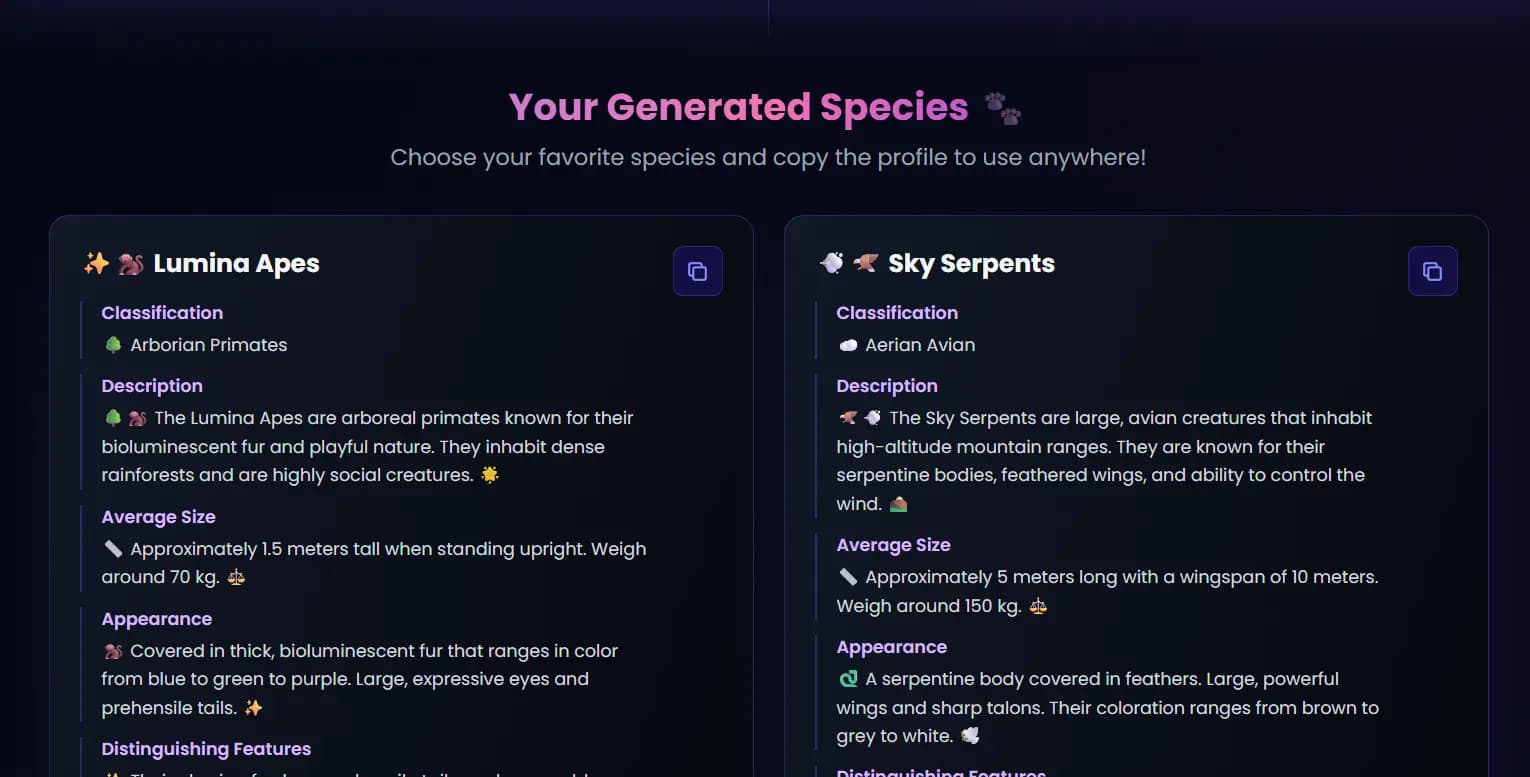
Each profile includes core biology, behavior, habitat, abilities, and weaknesses. If you prefer aliens, humanoids, or monsters, switch the type and regenerate for a different creative direction.
Why Use an AI Species Generator?
When you’re building worlds, time and momentum matter. A good AI species generator turns loose ideas into usable drafts—fast—so you can stay in the creative flow.
- Save hours: Get complete species profiles in minutes instead of sketching from scratch.
- Beat creative blocks: Use a quick random species generator pass to spark new directions.
- Richer worldbuilding: Generate biology, behavior, habitat, strengths, and weaknesses that fit your setting.
- Flexible by genre: Toggle for fantasy species generator vibes, sci‑fi aliens, humanoids, or monsters.
- Consistent details: Profiles stay internally coherent, so you spend less time fixing contradictions.
- Works for any project: Novels, game design, tabletop campaigns, or just exploring ideas.
- Simple workflow: Generate, review, and refine—use it as a practical species creator in your toolkit.
Understanding Species Design: Building Believable Lifeforms
Believable species don’t come from piling on cool traits—they grow from their world. The AI species generator leans on ecology and internal logic so your fictional species feel like they belong. If you’re using it like a fantasy species generator or a broader creature generator, these principles keep results grounded.
Environment and Adaptation
Start with the environment and work backward. A desert predator, an abyssal grazer, or an alpine glider will each evolve different solutions to survive.
- Aquatic species often favor streamlined bodies, fins, and pressure tolerance.
- Desert species conserve water, shed heat, and time activity around temperature swings.
- Aerial species optimize for lift and light frames; gliding vs powered flight changes anatomy.
- Subterranean species lean on vibration sensing, digging limbs, and low‑light vision.
Diet and Ecological Niche
Diet shapes anatomy and behavior. Define the niche, then let the details follow.
- Herbivores: grinding dentition, fermentation, herd behavior.
- Carnivores: pursuit or ambush strategies, claws/teeth specialization.
- Omnivores: adaptability, tool‑use potential, flexible social structures.
- Unusual diets: minerals, radiation, symbiosis—great for aliens and monsters.
Physical Characteristics
Form follows function. Choose a body plan that actually serves the niche.
- Body plan: bipedal, quadrupedal, serpentine, avian, cephalopodic.
- Scale and size: from tiny pollinators to colossal grazers.
- Coloration: camouflage, warning, mimicry, or display signals.
- Senses: sight, smell, echolocation, electroreception, magnetoreception.
- Special features: prehensile tails, gills, regenerative tissues, bio‑luminescence.
Behavior and Social Structure
Behavior is where species come alive. Social rules drive conflict, cooperation, and story hooks.
- Solitary vs social: territory, mating, parenting strategies.
- Pack dynamics: roles, signaling, resource sharing.
- Hive minds: collective intelligence, redundancy, specialization.
Abilities, Strengths, and Weaknesses
Interesting species have trade‑offs. If something is powerful, something else should cost them.
- Natural weapons: claws, beaks, venom, spines.
- Defenses: armor, toxins, camouflage, flight.
- Special abilities: regeneration, heat vision, psionics (for alien or fantasy creature concepts).
- Vulnerabilities: temperature limits, resource dependence, sensory blindspots.
Society and Culture (if Sentient)
For sentient or humanoid species, align culture with environment and history.
- Social organization: tribal, guild‑based, imperial, nomadic.
- Technology level: primitive, medieval, industrial, spacefaring.
- Cultural traits: honor codes, art forms, taboos, resource ethics.
- Values: survival, expansion, harmony, mastery—and why.
Naming Conventions
Names should fit the biology and culture you’ve outlined. Keep phonetics, morphology, and meaning in sync with the world.
Tips for Using a Species Generator Effectively
Treat the tool like a fast co-writer: generate, cherry-pick what works, and shape it to your setting. Whether you lean on a quick random species generator pass, a deeper fantasy species generator run, or a flexible creature generator for monsters and animals, the same habits make results stronger.
- Start with a concept: One sentence is enough (“arboreal gliders in a crimson jungle”).
- Use the keywords field: Add 2–5 sharp cues like “bioluminescent,” “nocturnal,” “hive-mind,” “alkaline lakes.”
- Dial in the environment: Terrestrial, aquatic, aerial, subterranean, or extreme—plus a biome for clarity.
- Toggle sentience smartly: Sentient species unlock culture, tech level, and social rules; non-sentient leans into ecology.
- Iterate with intent: Regenerate to explore branches, not to reroll the same idea. Keep what’s working.
- Balance strengths with weaknesses: Trade-offs make fictional species feel real and useful in stories or games.
- Fit the ecosystem: Define predators, prey, and competition—conflict creates story hooks.
- Swap modes when stuck: Try Humanoid or Alien for a different angle, then convert back if needed.
Frequently Asked Questions (FAQs)
Quick answers for using an AI species generator in worldbuilding—whether you’re drafting fictional species, testing a fast random species generator pass, or dialing in humanoids, aliens, and monsters.